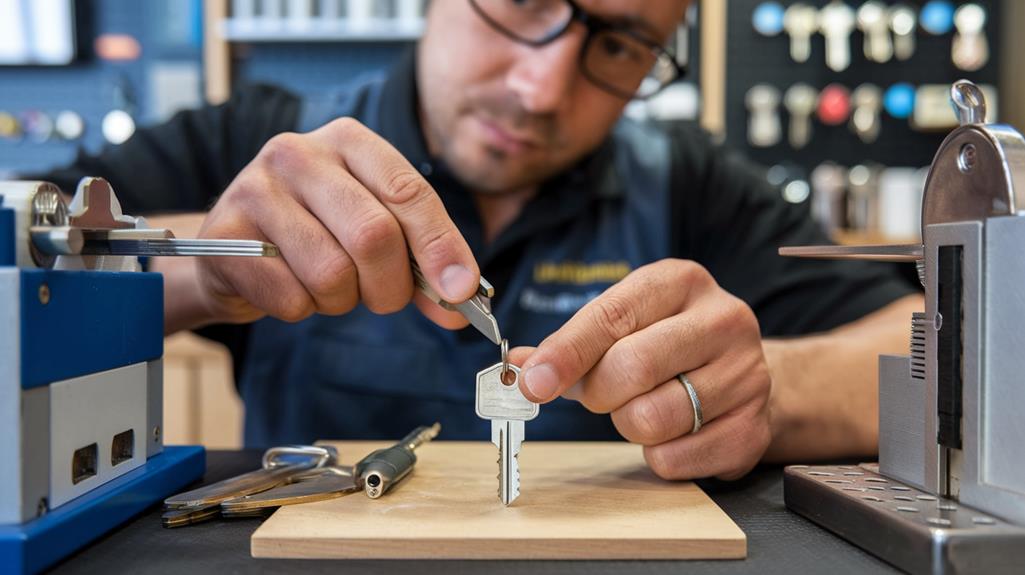
A standard house key is copied while you wait at the 24/7 Locksmith 4U shop on E. Flamingo Rd, cut from your original on a calibrated machine. Bring the original key, not a copy of a copy, and expect the duplicate to work on the first try.
Key duplication sounds trivial, and for a plain Kwikset or Schlage key it mostly is. The calls we get are from people whose copy sticks, only works upside down, or will not turn at all. Almost every one of those traces back to the same three mistakes: a worn original, the wrong blank, or a machine that was never calibrated. This guide covers where to get a house key copied in Las Vegas, which keys can and cannot be duplicated, and how to make sure the copy works.
Where to Get a House Key Copied in Las Vegas
Locksmith shop
A locksmith shop cuts on a manual or code machine that is checked against a gauge, uses the correct blank by keyway rather than by look, and tests the copy in a matching cylinder before you leave. Walk-in key cutting at 24/7 Locksmith 4U is available Monday to Friday, 8:30 AM to 5:00 PM, at 3620 E. Flamingo Rd, Unit #2, near Pecos, a short drive from Paradise, UNLV, and the Boulder Highway corridor. Standard blanks are a few dollars each; restricted or high-security keys are quoted per key. Confirm current pricing when you call or stop in.
Self-serve kiosks
The kiosks in grocery stores and big-box lobbies scan your key with a camera and cut a copy from that image. They work well on a clean, unworn standard key. They fail on worn keys, because the scanner copies the wear, and they cannot handle anything outside the most common keyways.
Hardware stores
Big-box hardware counters use a duplicating machine that traces your original with a stylus. Results depend on whether the machine has been calibrated recently and whether the employee picks the right blank. A copy that works “if you jiggle it” usually came from a tracing machine that is a few thousandths of an inch off.
Mobile, during a locksmith visit
When our technician is already at your home in Henderson, Sunrise Manor, or Whitney for a rekey or lock installation, extra keys are cut from the truck during the same visit. That is the cheapest way to end up with four or five matching copies for a household.
Which House Keys Can Be Duplicated
| Key type | Can it be copied? | Notes |
|---|---|---|
| Kwikset (KW1, KW10) and Schlage (SC1, SC4) | Yes, anywhere | Most Las Vegas homes built since the 1990s use one of these |
| Weiser, Baldwin, Yale residential | Yes | Kiosks may not stock the blank; a locksmith shop will |
| Smart lock override key | Yes | Usually a Kwikset or Schlage keyway; copy it before you need it |
| “Do Not Duplicate” stamped keys | Usually yes | The stamp is a request, not a legal restriction, unless the keyway is patented |
| Medeco, Mul-T-Lock, Schlage Primus, other restricted keyways | Only with authorization | Blanks are controlled; you need the owner card or proof you own the lock |
| USPS mailbox (arrow) keys | No | Federal property; the post office issues them |
| Community mailbox tenant keys | Usually yes | Standard keyway on most cluster boxes; some HOAs restrict them |
Why Duplicate Keys Fail
Copying a copy
Every duplicate carries a small error. Copy the copy and the errors stack. By the third generation the key may not turn. Keep one original that never leaves the house and cut every spare from that one.
A worn original
Keys wear on the tips of the cuts. Las Vegas dust acts like fine sandpaper inside a keyway, so an original that has been in daily use for ten years on a door facing the wind is probably worn. A tracing machine copies the wear. A locksmith can instead cut by code, reading the original depths and producing a fresh key to factory spec, which often works better than the worn original.
The wrong blank
Kwikset and Schlage keys look similar but have different keyways. A close-enough blank will cut fine and then refuse to enter the lock, or enter and bind. A shop matches the blank by keyway profile, not by eye.
The lock, not the key
If every key, including the original, has started to stick, the problem is the cylinder. Dust, a sagging door, or a strike plate that shifted when the frame expanded in summer heat will make a perfect key feel wrong. That is a lock repair, not a key issue. Our residential locksmith page covers repairs and how they are quoted.
How Many Spare Keys You Need
One for each adult in the household, one hidden in a wall-mounted lockbox with a code (never under a mat or planter), and one with a trusted neighbor or relative. Renters should check the lease: many Las Vegas apartment communities limit copies and charge for each key not returned at move-out. Property managers who need dozens of keys for turnover usually prefer that we rekey units to a master system and cut keys in bulk; the commercial locksmith team handles that.
Car Keys Are a Different Job
A house key is metal only. Most car keys made since the late 1990s carry a transponder chip that has to be programmed to the vehicle, and many are laser cut. Kiosks and hardware counters cannot do that. A mobile automotive locksmith cuts and programs a duplicate at your location, quoted upfront for your vehicle, which is far cheaper than an all-keys-lost job later.
Tips for a Copy That Works the First Time
- Bring the original, and tell the cutter if it is old or has ever been copied.
- Test the new key in the actual lock before you rely on it, from outside, with the door open.
- If a new key needs jiggling, take it back. A correctly cut key turns smoothly.
- Ask for a code cut if the original is worn.
- Have all your exterior doors keyed alike during a rekey so one key runs everything and you carry fewer spares.
- Store one key you never use so future copies come from a fresh original.
When to Call 24/7 Locksmith 4U
Stop by 3620 E. Flamingo Rd, Unit #2, Las Vegas, NV 89121, Monday to Friday, 8:30 AM to 5:00 PM for walk-in key cutting, or call 725-303-0655 any hour if you are locked out, down to your last key, or need keys cut on site during a rekey. Mobile visits are quoted upfront and dispatched fast across East Las Vegas and Paradise. Read more about us, or use the contact page to ask about a specific key before you drive over. If your keys are already missing, start with our guide to lost or stolen keys in Las Vegas.
House Key Duplication FAQ
How long does it take to copy a house key?
Only a few minutes for a standard Kwikset or Schlage key at a locksmith shop, including testing the copy. Restricted or high-security keys take longer and require proof of ownership before the blank is released.
Can I copy a key marked “Do Not Duplicate”?
Usually yes. The stamp has no legal force on a standard keyway; it is a request from whoever issued the key. Patented restricted keyways such as Medeco or Mul-T-Lock are the exception, and those require an authorization card or proof you own the lock.
Why does my new key only work sometimes?
The copy is a few thousandths off, the blank is slightly wrong, or the original it was cut from is worn. Take it back for a recut, or have a locksmith cut a fresh key by code from the original’s depths.
Can a locksmith make a house key without the original?
Yes. A technician can decode the lock cylinder and cut a new key, or rekey the lock and cut new keys at the same visit. Rekeying a single lock is quoted upfront and is often the better option when no key exists.
Is a locksmith shop more expensive than a kiosk for a key copy?
Standard blanks are a few dollars either way. The difference is accuracy: a shop cuts from a calibrated machine, matches the blank by keyway, and tests the copy, which is why keys that failed at a kiosk usually work after a shop recut.